How to Solve a 2x2 Rubik’s Cube: Step-by-Step Beginner’s Guide (2026)
At WOWCube, we owe a lot to the Rubik’s Cube. Most of our team grew up twisting one, and the console we ended up building is shaped like a 2x2 cube. So when people ask us how to solve a 2x2 Rubik’s Cube, it’s a question that hits close to home, and we wanted to give you the clearest answer we could.
Here’s how to solve a 2x2 Rubik’s Cube, beginner edition. You work in three steps. First, solve the first layer by building one face so the side colors of every corner match. Next, orient the top layer so the opposite face turns one solid color. Finally, move the top corners into their correct spots and the cube is done. The whole method for beginners runs on just two or three short algorithms, and once they click, you can solve a Rubik’s Cube 2x2 from any scramble.
What is a 2x2 Rubik’s Cube?
A 2x2 Rubik’s Cube, also known as the Pocket Cube or Mini Cube, is the smaller sibling of the classic 3x3. It’s made of just eight corner pieces. There are no center pieces and no edge pieces, so every piece you turn carries three colored stickers.
That missing center changes how you approach the puzzle. On a 3x3, the center of each face tells you what color that face should be. On a 2x2 nothing stays fixed, which means you can start with any color you like and let the corners themselves guide you. If two corners share a side color, they belong next to each other.
Fewer pieces means fewer things to track. If you’ve been searching how to solve a Rubik’s Cube for beginners, 2x2 is the right place to start. Once you know how to solve Rubik’s Cube 2x2 positions, the moves carry straight over to the 3x3.
2x2 Rubik’s Cube Notation (Read This First)
Every algorithm in this guide is written in standard cube notation, so take two minutes to learn it before you jump into the steps. Each letter stands for one face of the cube, and each move is a quarter turn of that face.
| Move | Face | What it means |
|---|---|---|
| R | Right | Turn the right face clockwise |
| L | Left | Turn the left face clockwise |
| U | Up | Turn the top face clockwise |
| D | Down | Turn the bottom face clockwise |
| F | Front | Turn the face pointing at you clockwise |
| B | Back | Turn the face pointing away from you clockwise |
| R’ | Right | An apostrophe means counterclockwise |
| R2 | Right | A 2 means turn the face twice (180°) |
The apostrophe and the 2 work the same way on every letter, so U’ is the top face counterclockwise and F2 is the front face turned twice.
Now for the part that trips everyone up. Think of this as how to solve a 2x2 Rubik’s Cube for dummies, starting with how you hold it. Hold the cube in front of you with one face pointed at your chest. That’s your front, and you keep the cube in that exact position for the whole algorithm. “Clockwise” always means clockwise as if you were looking straight at the face you’re turning. In practice, that looks like this from where you’re sitting. R moves the front stickers of the right side up, while L moves the front stickers of the left side down. U slides the front stickers of the top layer to the left, and D slides the bottom ones to the right. F turns clockwise exactly the way you’d expect. B is the sneaky one, because clockwise from behind looks counterclockwise from the front.
If an algorithm ever goes sideways, nine times out of ten it’s because the cube got rotated in your hands halfway through. Keep your grip steady and the notation takes care of the rest.
How to Solve a 2x2 Rubik’s Cube Step by Step
This is how to solve a 2x2 Rubik’s Cube for beginners, using the same method we’d teach a friend across the table. We’ll use white for the first layer and yellow for the last, since those sit opposite each other on a standard cube. To keep how to solve a Rubik’s Cube 2x2 step by step easy to follow, each step below tells you the goal, what the result should look like, the algorithm to use, and what to do if it doesn’t work out the first time.
Step 1: Solve the First Layer
Goal: build a complete white face where the side colors of all four corners match their neighbors.
How to do it: find any white corner and put it on the bottom with white facing down. That corner is your anchor. For each of the other three, turn the whole cube so the empty slot sits at the front right of the bottom layer. Find the white corner that belongs there (its two side colors will match the corners next to the slot), then turn the top layer until that corner sits directly above the empty slot.
Algorithm: R U R’ U’
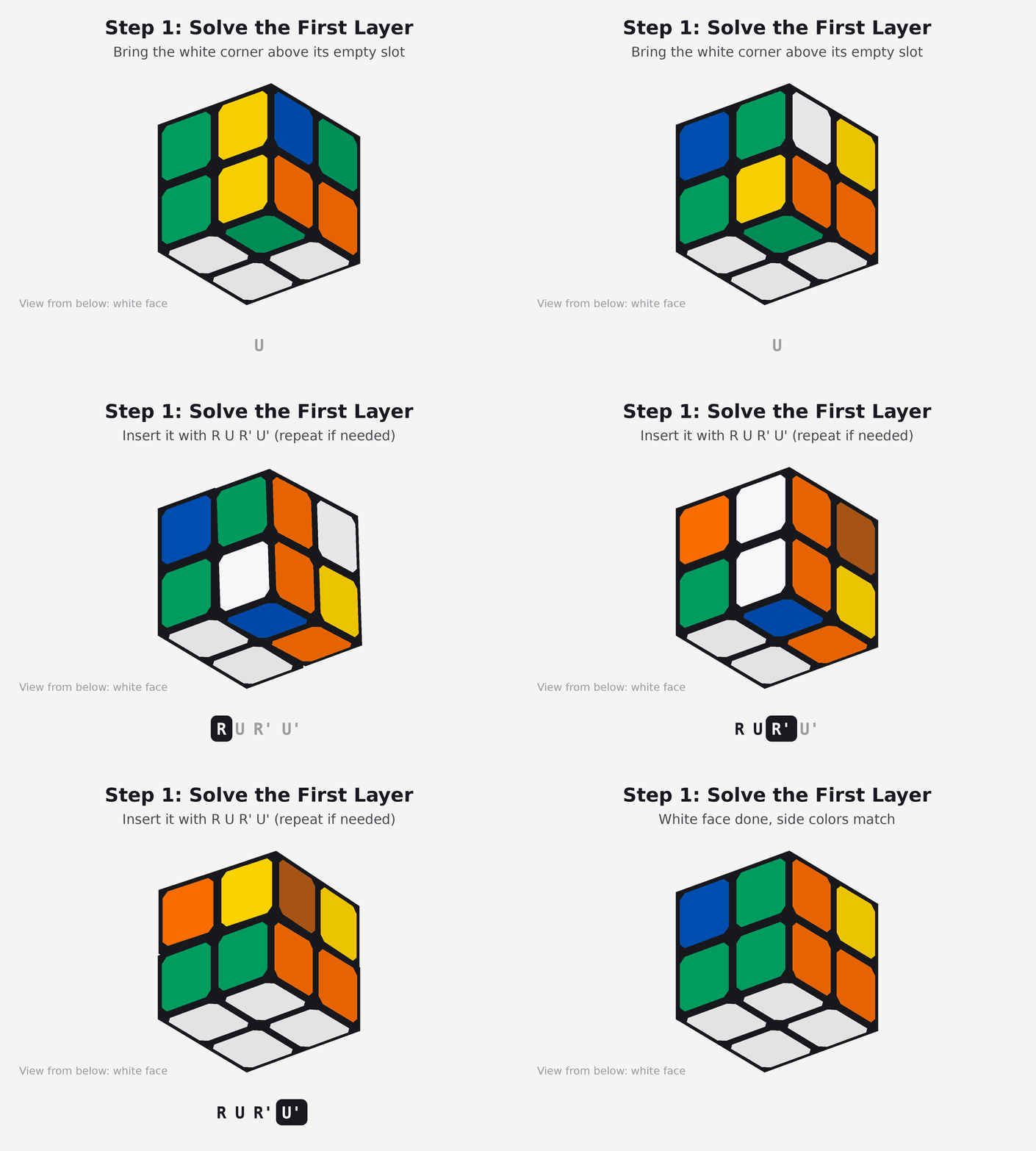
Repeat it until the corner drops into place with white facing down. Depending on how the corner is twisted, that takes one, three, or five repetitions. Then move on to the next empty slot.
If it didn’t work: a white corner stuck in the bottom layer in the wrong spot or twisted the wrong way just needs to be freed. Hold it at the front right of the bottom layer, do R U R’ U’ once to lift it into the top layer, and insert it again normally. If the white face is complete but the side colors don’t match, one corner is in the wrong slot, and the same trick pops it out.
Step 2: Orient the Top Layer
Goal: turn the whole top face yellow. The sides of the top layer don’t need to match yet.
How to do it: flip the cube over so the white face is on the bottom and yellow is on top. Count how many yellow stickers are facing up. If exactly one is facing up, turn the top layer until that corner sits at the front left. If none or two are facing up, turn the top layer until the front left corner has its yellow sticker pointing to the left. Then run the algorithm.
Algorithm: R U R’ U R U2 R’
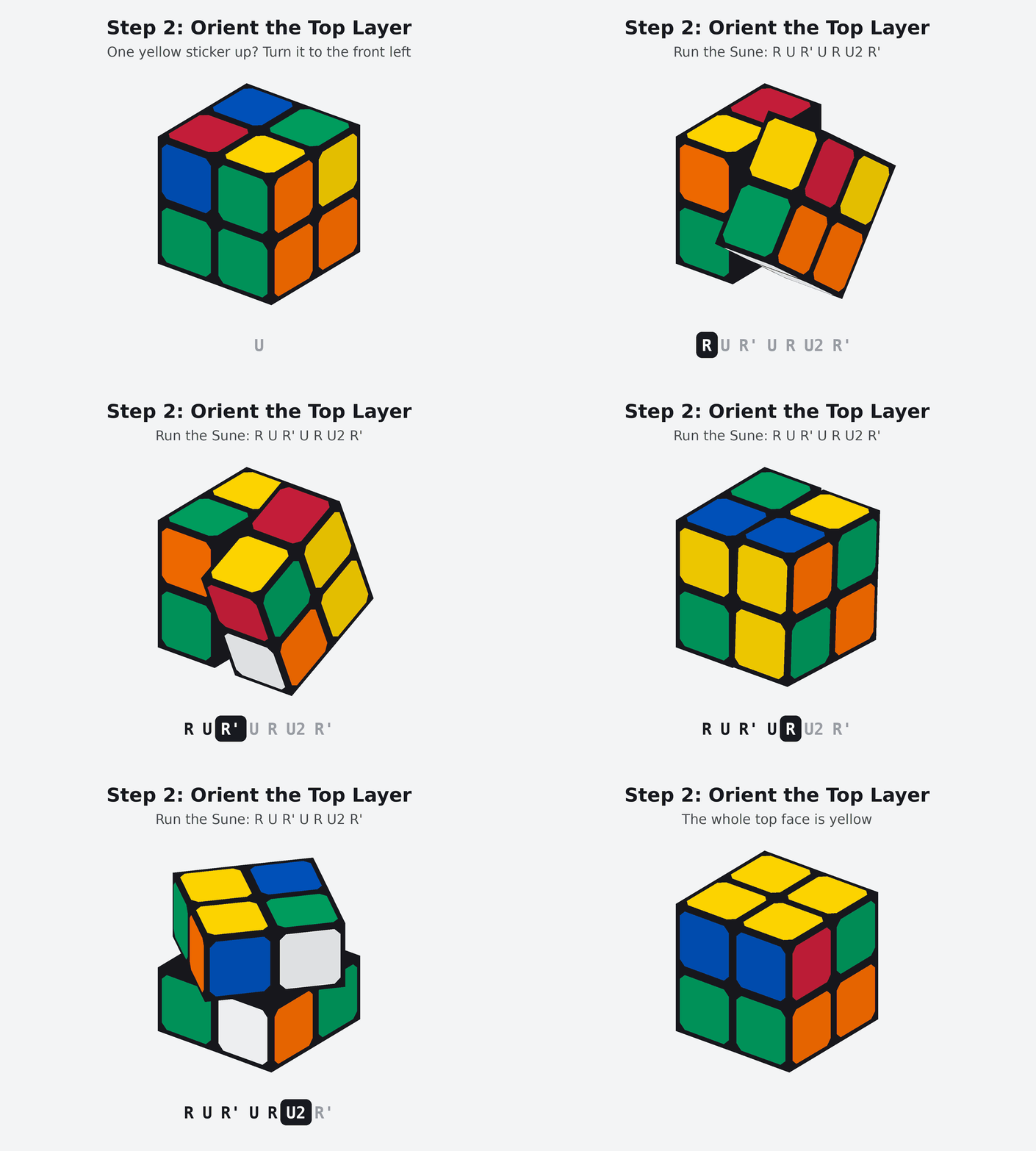
Cubers call this one the Sune. After each run, count the yellow stickers again, reposition the top layer by the same rule, and repeat. Most cases finish in one to three runs.
If it didn’t work: if your white layer comes out scrambled after the algorithm ends, a move got misread or the cube shifted in your grip. Go back to Step 1, rebuild the white face, and try again slowly. It’s also worth checking you’re doing U2 as two full top turns, not one.
Step 3: Position the Top Corners
Goal: move all four top corners into their correct spots so every side of the cube is one solid color.
How to do it: look at the top row of each side and search for “headlights,” a side where both top stickers are the same color. If you find one pair, turn the top layer so the headlights face left, then run the algorithm. If there are no headlights at all, run the algorithm once from any angle and a pair will show up. Then use the headlights rule and run it one more time.
Algorithm: R U R’ U’ R’ F R2 U’ R’ U’ R U R’ F’
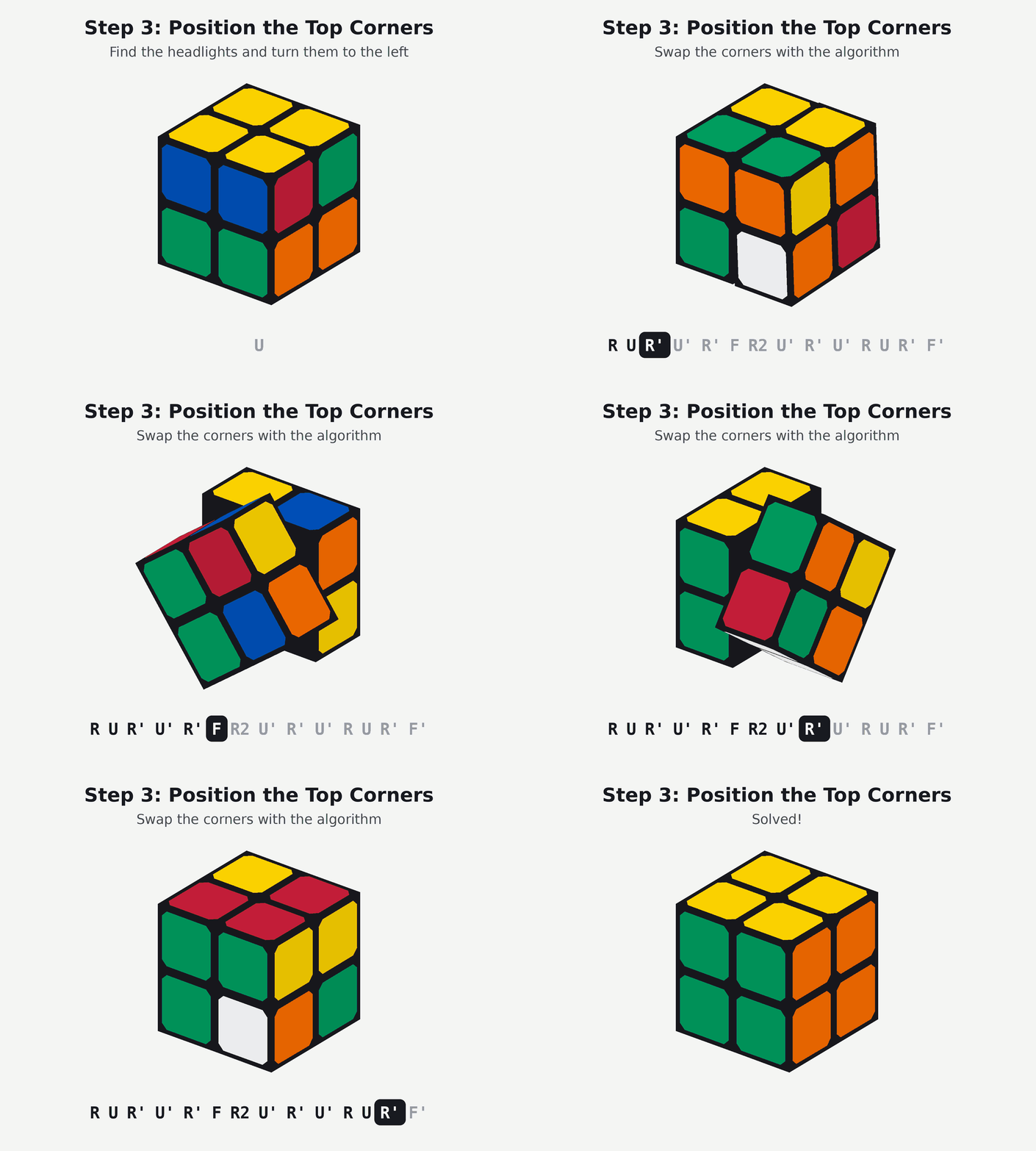
When it’s done, turn the top layer until every side lines up and the 2x2 is solved. If all four sides already show headlights, you can skip the algorithm and just turn the top.
If it didn’t work: this is the longest algorithm in the guide, so a slip is normal. If the yellow face is still intact, go back to looking for headlights and run it again. If the yellow face broke, return to Step 2. Breaking it into chunks of three or four moves makes it much easier to memorize.
Essential 2x2 Algorithms
If you bookmark one part of this guide on how to solve 2x2 Rubik’s Cube puzzles, make it this table. It has every algorithm in one place. Save it, screenshot it, or keep it open next to you until your hands know the moves on their own.
| Step | Algorithm | When to use it |
|---|---|---|
| 1. First layer | R U R’ U’ | A white corner sits right above its empty slot. Repeat until it drops in with white facing down. Also frees a corner stuck in the wrong slot. |
| 2. Orient the top layer | R U R’ U R U2 R’ | White layer is solved and the top isn’t fully yellow yet. Position the top layer first, then repeat as needed. |
| 3. Position the top corners | R U R’ U’ R’ F R2 U’ R’ U’ R U R’ F’ | Top is fully yellow but the corners are in the wrong spots. Hold the headlights on the left. |
Once the beginner method feels easy, there are faster ways to solve a 2x2 Rubik’s Cube. The Ortega method has you build one face without worrying about the side colors, orient the opposite face, and then fix both layers at once. It’s the go-to upgrade for most people because it trims a lot of moves with a manageable number of algorithms. CLL builds a full first layer and then solves the entire top layer in a single algorithm, which means learning more cases but getting a big speed boost in return. EG is what the top competitors use. You build one face and finish the rest of the cube in one algorithm, and it takes serious dedication to learn.
Can You Use a 2x2 Rubik’s Cube Solver Online?
Yes. Type in Rubik’s Cube solver online 2x2 and you’ll find plenty of free options. A Rubik’s Cube solver 2x2 online tool lets you enter the colors of each sticker on your cube, and it spits out a sequence of moves that solves it. Since any 2x2 position can be solved in 11 moves or fewer, the solutions these tools give you are usually short and clean.
We’ll be straight with you, though. We don’t have our own solver, and a solver won’t teach you how to solve a 2x2 Rubik’s Cube. It hands you an answer for one specific scramble, and the next scramble puts you right back where you started. An online solver is useful when you’re truly stuck, when you want to reset a cube someone else scrambled, or when you want to check how far your own solution was from the shortest one. If you actually want to learn how to solve 2x2 Rubik’s Cube step by step, stick with the method above.
Tips for Practice and Improvement
Once you know how to solve a 2x2 Rubik’s Cube, the next goal is doing it smoothly. Start by drilling each algorithm slowly until you can run it without looking at the notation, because speed comes on its own once your hands stop hesitating. After that, focus on recognition. The faster you can spot which case you’re looking at, the less time you spend staring at the cube between moves.
Grab a timer and track your solves, even if your first ones take a few minutes. Seeing your time go down keeps you coming back. Try to keep the cube in one position while you work and turn it only when a step calls for it, since every unnecessary rotation costs you time and causes mistakes. And when this guide on how to solve a Rubik’s Cube 2x2 for beginners starts to feel automatic, that’s your cue to look into Ortega.
If you want to keep practicing between solves, WOWCube makes it easy. It’s a gaming console built as a 2x2 cube with 24 screens, and it has its own Rubik’s Cube game, so you can work on the same turns you just learned right on the device. There’s also the Rubik’s WOWCube, an officially licensed collaboration with Rubik’s. If you grew up with a cube in your hands, it’s a fun way to pick the habit back up.