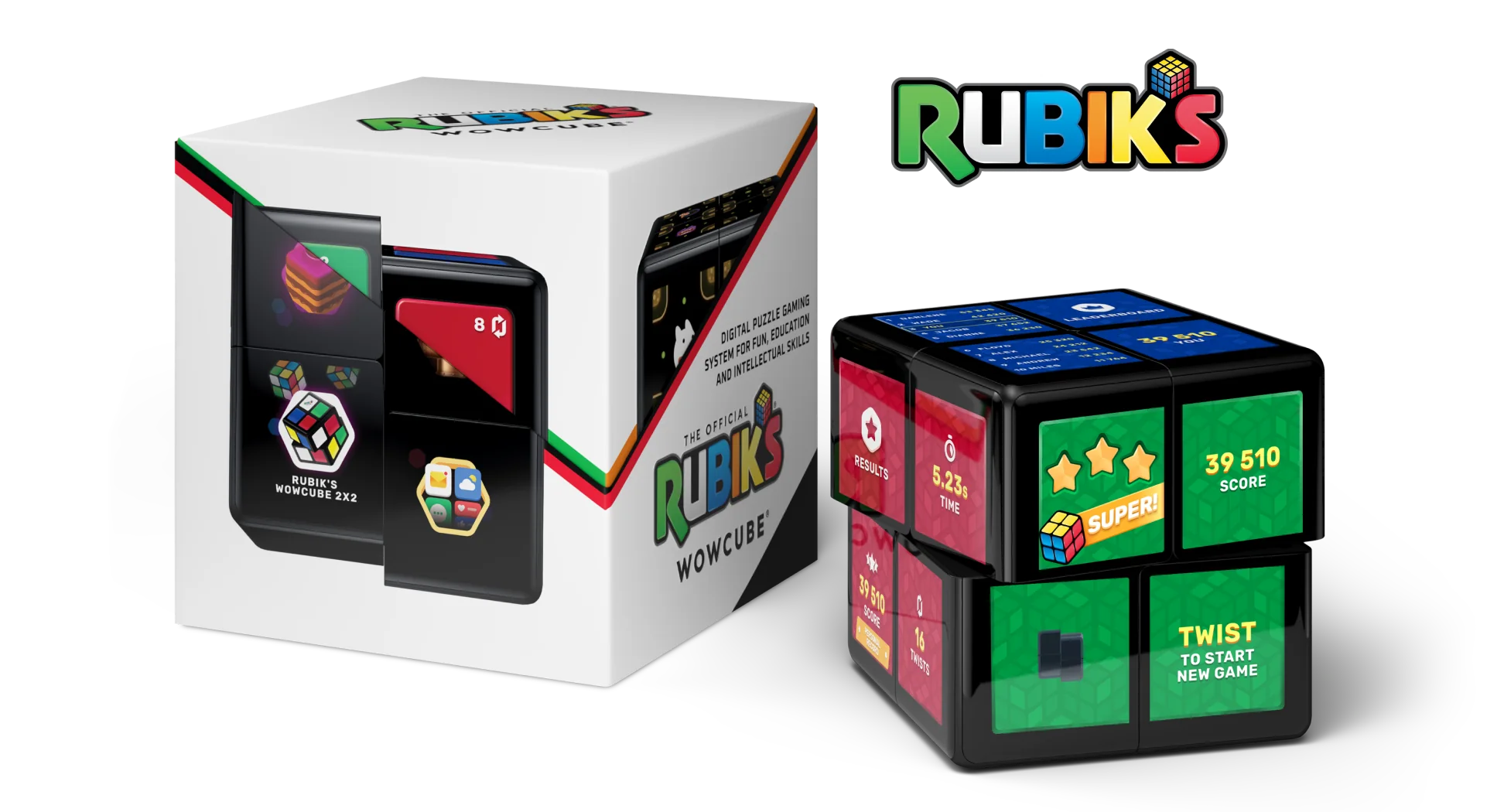
WOWCube® Entertainment System and Game Development
The WOWCube® store has more than 40 games now. We develop games that entertain you, give you pleasure, and recharge your brain. However, when we talk about game development for the WOWCube® Entertainment System, we should always keep the “hidden agenda” in mind. What does that mean?
Well, first of all, it’s a community. Our team creates game examples that developers can use and follow the coding and design standards. The device we made is very unusual. Compared to other devices, it has a very advanced geometry and unique architecture. The game field itself can change in the “real” world, not just in the virtual one. As far as we know, there are no analogs so far.

So this is a new experience, and developers will benefit greatly if we guide them by examples, with real game play. That is the first part of the “hidden agenda” - to motivate 3rd party developers to design games in our DevKit based on the examples that our team already created.
The second part is to show the WOWCube® capabilities to the public. It’s very important to prove that we know what we are doing, because it is not enough to just say “ok, we have a Rubik’s cube with screens”. We MUST prove that it will be interesting to play with. So we created games of different genres to illustrate different capabilities of our device.
How It All Began
The first thing we thought when we created the first game for the WOWCube® Entertainment System was “let’s draw something, and make a gamer pull it together”. We had a game with six faces on six sides of a cube which morphed into each other.
The second idea was: what if characters could move from one side to another? This was one of our first proof of concept demos, not even games yet. Sides were painted different colors, and they melted into each other as you turned them.
In 2018, our electronics engineer Simon Orlov wrote the Steampipes game and a game with a large number of randomly-moving balls which the gamer moved into a “trap”.
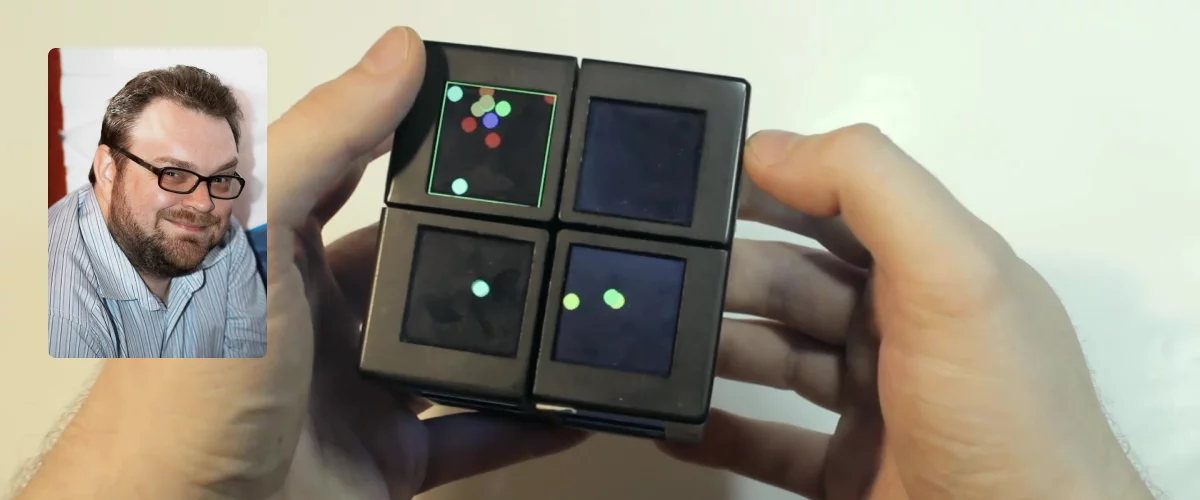
He also wrote the first version of Butterflies, the game where insects come alive after you move their parts into correct positions. These two games survive to this day.

The games evolved with the cube. It was a huge development challenge because when the parts of a cube move, all screens should work together, each must have the coordinates grid, and the code had to “understand” where it all is. “Had” in the past tense, as now the OS does most of that work.
The first games, Steampipes and Butterflies, were written as part of the firmware. When we went to our first exhibition, we had three prototypes: one with Steampipes, one with Butterflies, and one with a ball rolling over all screens. So initially, the game was hardwired, the WOWCube® Entertainment System didn’t support installing games. Later, we added an OS layer, the ability to download games, a connection to mobile phones, a game development kit, etc.
Game Development Process
This is how we develop: we get the idea, and then discuss it internally within the team. Then, we turn the idea into a game design document. In this document, we describe everything about how the game should work. Then we program just one level, no Web side, no boards. Just a bit of game play. Because we need to figure out if playing this game is interesting. We run it at different speeds and difficulty levels, add and remove elements. After this test, we begin adding graphics, music, levels, and so on.

Game Design Language
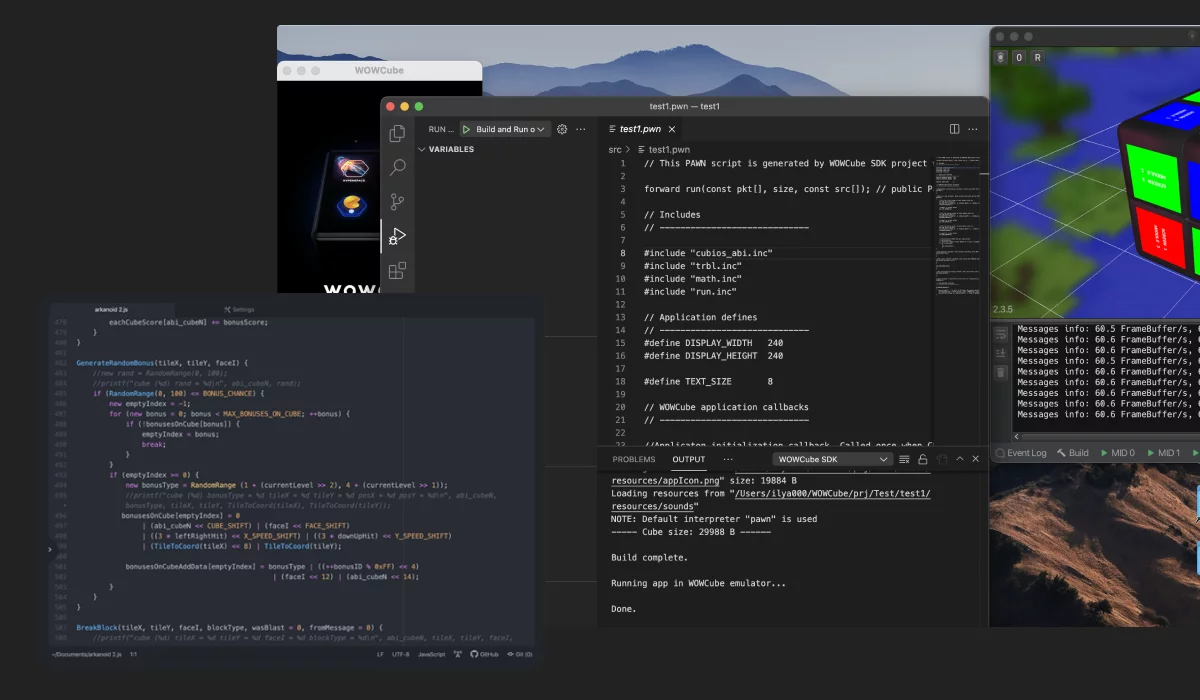
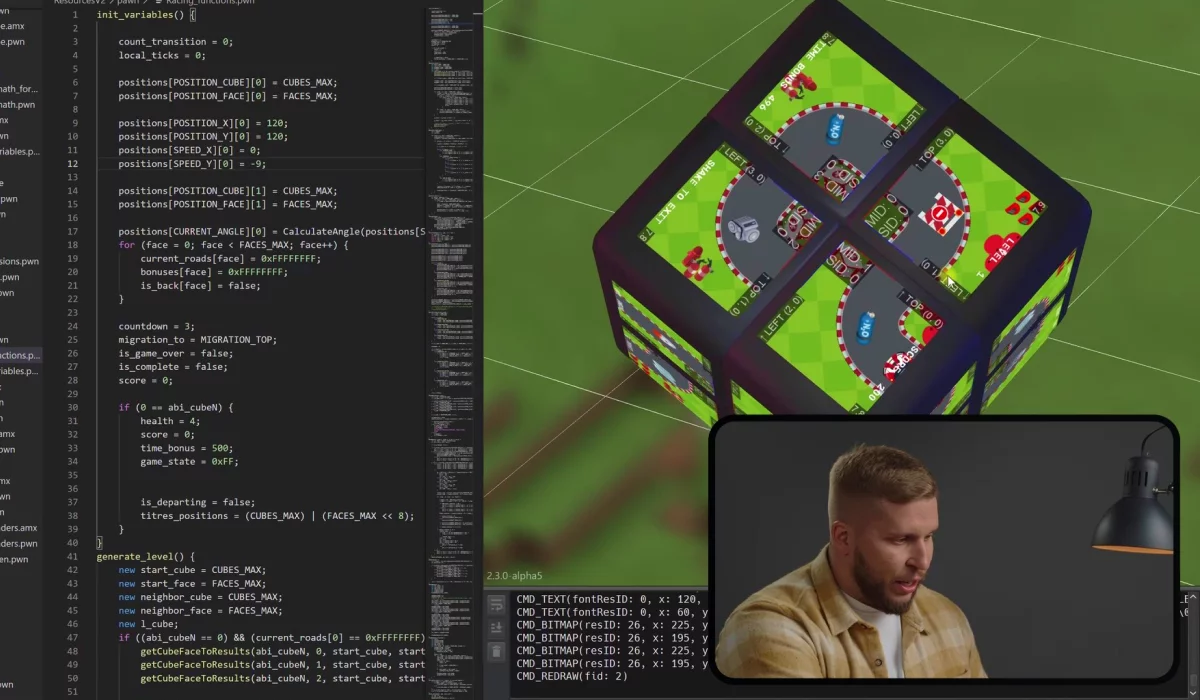
Speaking of programming languages, right now we support two virtual machines, PAWN and WASM. PAWN is just a simplified version of a C language. WASM supports a universal bytecode, so it can be generated using many different languages: C, C++, and so on. It’s great because programmers can use a familiar language.
One more thing related to programming. The WOWCube® Entertainment System is more of a toy than a computer. We should not run just anything on it. As a result, we can use cost-effective solutions, which reduces the price. It does have a graphics accelerator, but only a 2D one. It is not a smartphone.
Who Develops Games Now?
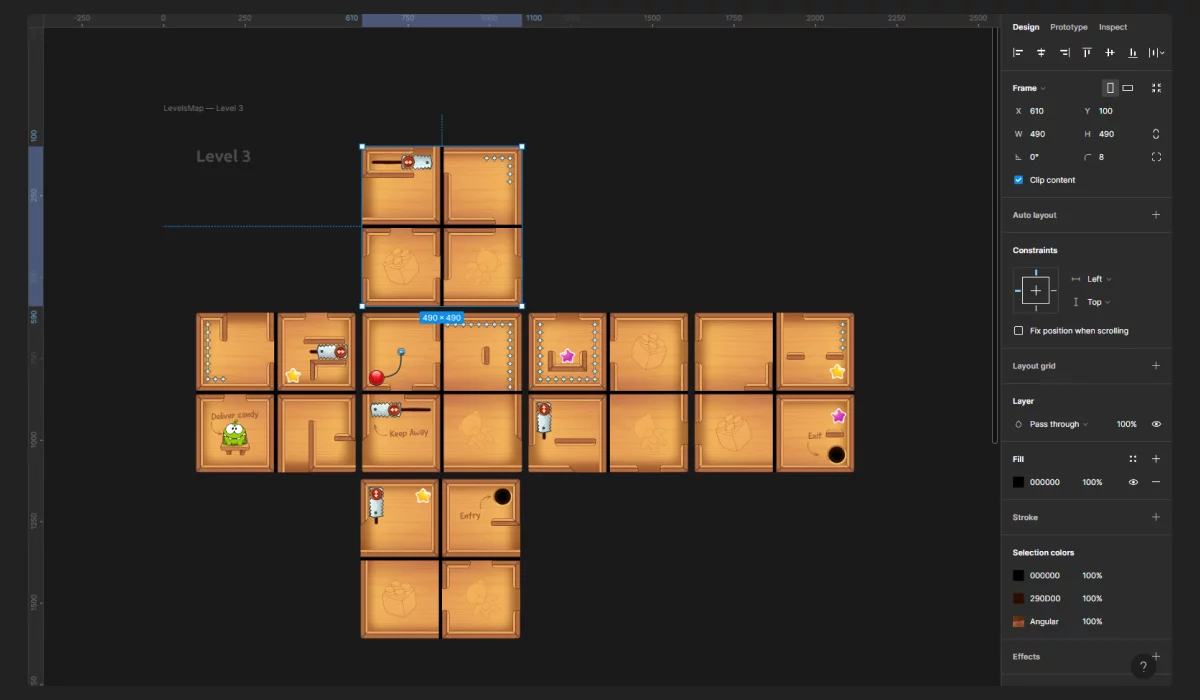
The first who take the game into development are the designers. They create the foundation, the visual world of the game. One of the first designers of the WOWCube® games was Valentin Zubkov who did almost all the design work. Then the team has grown, and people start to specialize in specific areas. Now there are graphic designers who draw pictures, UI/UX designers who are constantly improving the user interface and experience.
Our music expert is responsible for all clicks, menu sounds, loading games sounds, etc.
Then, after the design creation, the game goes to programmers who write the game code. In addition to game developers, other professions are involved. First, OS programmers, because our games use the OS, and game programmers often request new features.
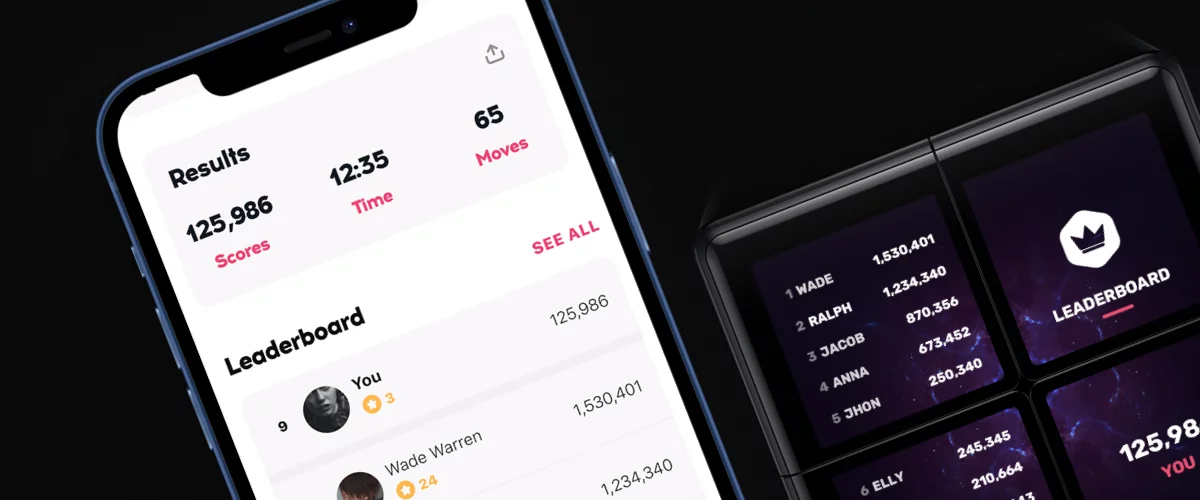
Then, ecosystem developers. The game has to work with the leaderboard, so it is stored in memory and, when connected, is sent to the Web. The WOWCube® Entertainment System is not always online, so it is accumulating the data, which is a non-trivial task.
Then we have the back end, which is the code that runs on servers. Both mobile and Web code. For games on the WOWCube® System it is not important to have a connection to the server, but it is important for installing new games and updates.
There is also the creative part, so we need a gameplay designer, the person who plans the sequences of events in a game. Plus core, metagame, all boards, achievements, levels, and all that has to be invented and explained to programmers, designers, and sound experts. One person invents a game, another person draws it, and another writes the code – this is teamwork in the true sense. They interact with with OS programmers.
Plus, let’s not forget the people that work for us part time, and students. For example, Anna is studying game design in California, and she developed a few very interesting games as a game designer.
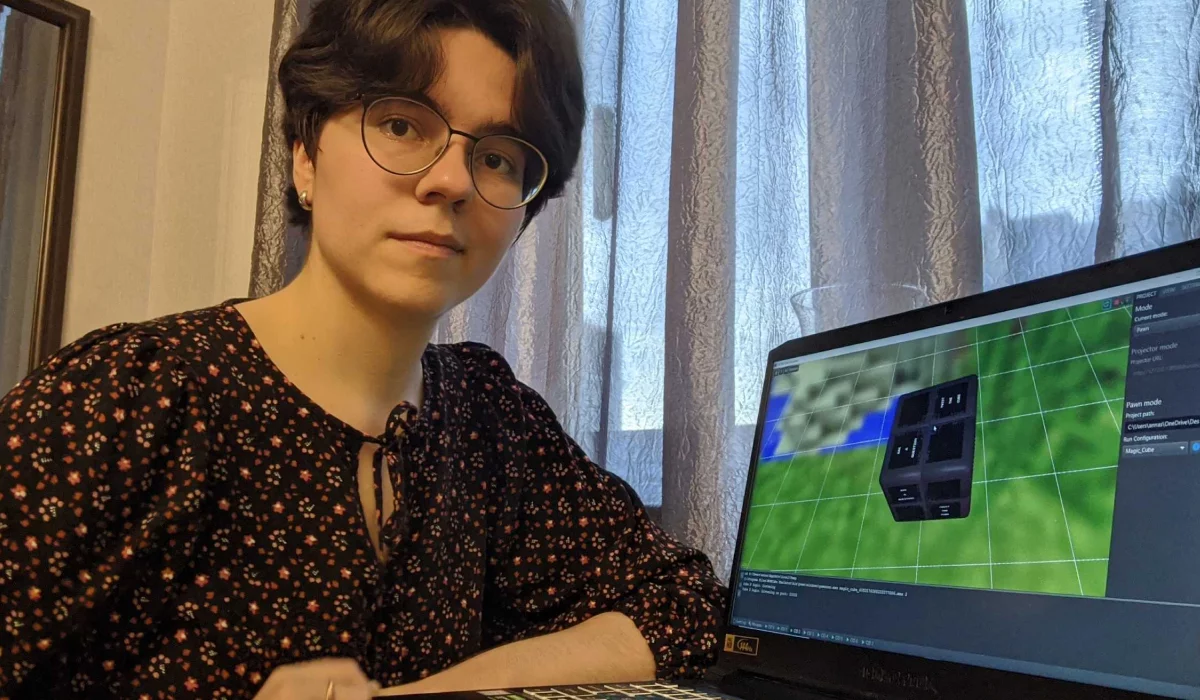
We also have students from Lausanne, Switzerland. We especially welcome students that study game design and computer graphics.
WOWCube® Game Store
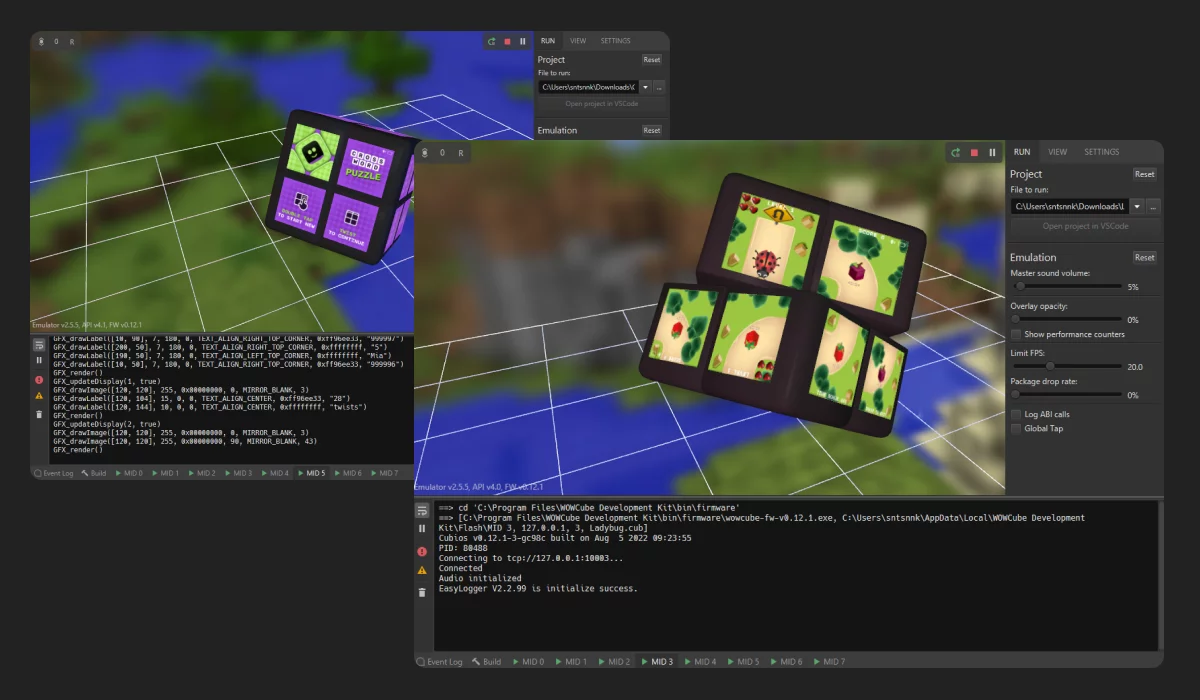
We already have a Web store for applications created by 3rd party developers. We have a powerful DevKit, which includes the 3D emulator of the WOWCube® Entertainment System, capable of running programs on the PC.
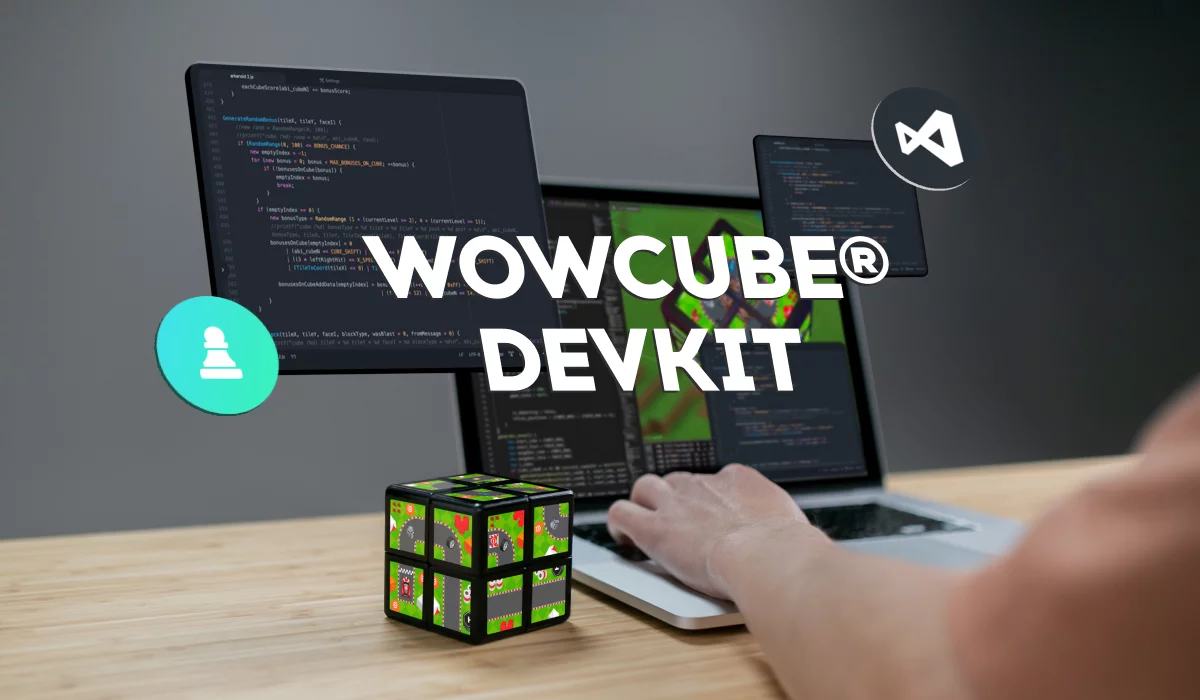
It is cross-platform, it works on Windows, MacOs, and Linux. We also have a plugin for cross-platform development in Visual Studio Code. The plugin allows developers to write code, publish apps in our store, and run them both on the emulator and the real WOWCube® Entertainment System. WOWCube® DevKit will be published for 3rd party developers this fall.
As for the store, it has a Web version, and mobile versions for Android and iOS.
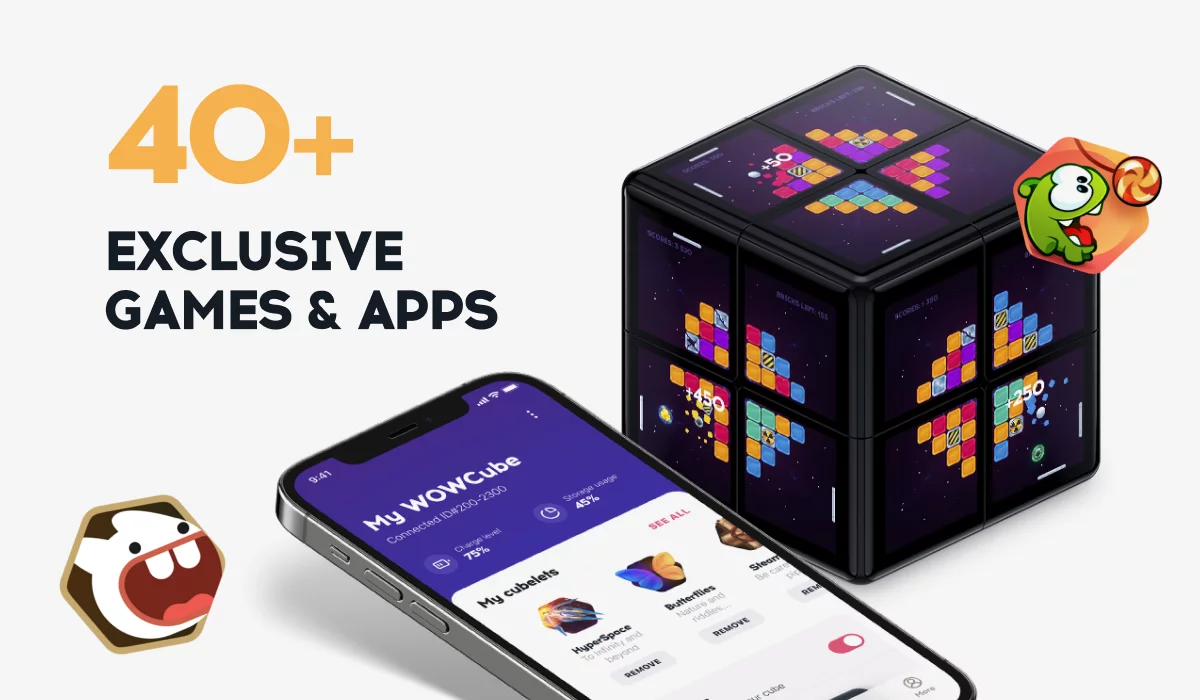
The smartphone can get the app from the store and transfer it to the cube. We have a very interesting method that we call ad hoc: when a developer publishes the application’s beta, the app is not published in the store yet, but gets an address, so developers can send it to friends for testing. The store contains both applications written by us and by “friendly developers” who help us test and improve the entire ecosystem.
What’s Next?
We worked very hard on the infrastructure for game development. This effort produced an OS that is able to “understand” the integrity of a WOWCube® Entertainment System. The cube consists of eight processors, and a game works on all eight simultaneously. The OS coordinates the information about all rotations, tilting, twisting, shaking, etc.
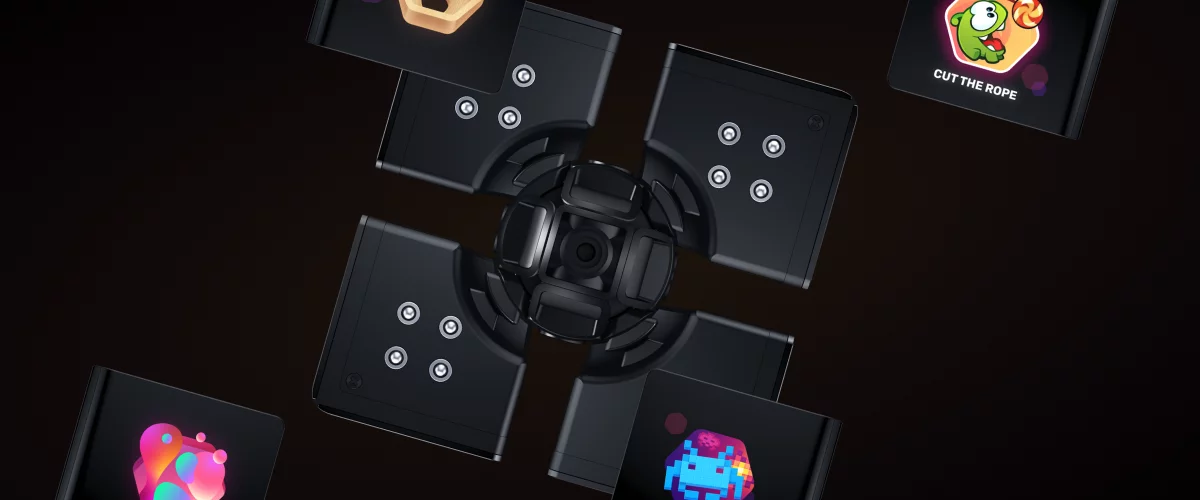
It also starts and kills the game, saves the results, refreshes the game from the server and sends results to the server, supports graphics and audio APIs, sprite animation, sending data between modules, and monitoring the WOCube® Entertainment System geometry. For example, if a character has to go from one screen to another during the game, the OS keeps track of all “forms” and “tos”. Plus, it also works with mobile phones, supports connectivity over the BT, monitors charge level, etc.

We hope that in the future, most games for the WOWCube® Entertainment System will be created by 3rd party developers. As for us, we will simply moderate, making sure the games that are uploaded to our store are of high quality. Just keep in mind that often, the games that make it to the top are simple.
In the future, WOWCube® Entertainment System will be able to work with external devices such as headsets, neuro-brain interface… we are getting there. Plus, we plan to be able to connect several WOWCube® Systems directly. Also, the OS will be able to work with a smart charger based on a Raspberry Pi and all the protocols will be published for everyone.
The WOWCube® Entertainment System has a new geometry, it creates new possibilities, so we hope that someone will create a new super hit that will take over the world.