Rubik's Magic Puzzle: History, How It Works & How to Solve It
Ernő Rubik will always be the cube guy, and fair enough. But the cube isn't the only puzzle he ever made, and Rubik's Magic might be the strangest one of the bunch. We have a soft spot for it here at WOWCube. In a way, our own device grew out of the same itch: the idea that a puzzle doesn't have to be about faces and turns at all.
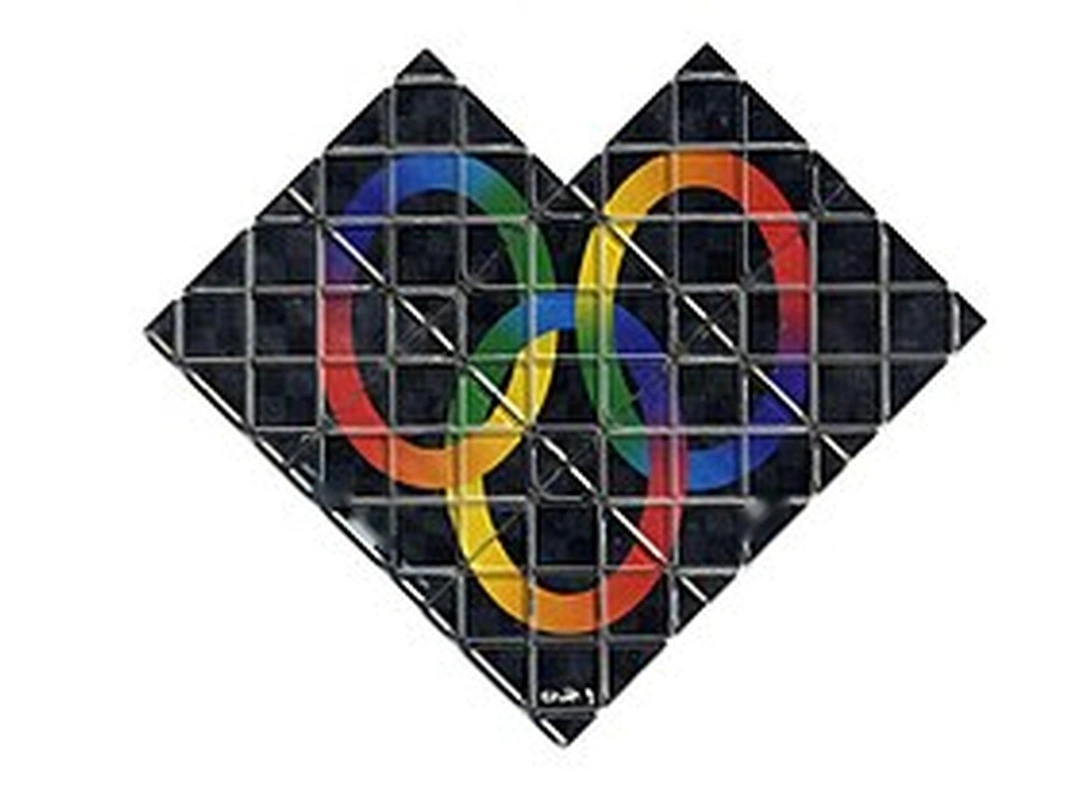
Rubik's Magic is a folding puzzle invented by Ernő Rubik and first released by Matchbox in the mid 1980s. It's made of eight square tiles laid out in a 2×4 rectangle and held together by thin wires that run through diagonal grooves. The front shows three separate rings. Your job is to fold the tiles into a heart shape, a 3×3 square with one corner missing, so the picture on the back comes together as three linked rings. There's no twisting involved. Every move is a fold.
What Is Rubik's Magic?
Rubik's Magic is a set of eight square tiles arranged in a 2×4 rectangle. The original tiles were black. Later editions switched to red tiles with gold rings, which is the version most people picture today.
The clever part is how the tiles are connected. Thin wires sit in diagonal grooves across each tile, which lets any pair fold over each other and open back out in two directions. If you've ever played with a Jacob's ladder toy, you already know the feeling.
In the starting position, the front shows three separate, rainbow colored rings. The back shows the same three rings, only scrambled. To solve it, you fold the eight tiles into a heart shape, which is a 3×3 square with one corner missing, and the rings on the back link up into one clean picture.
So why "Magic"? Because that's exactly what it looks like in your hands. You fold a pair of tiles, open them the other way, and suddenly a tile has a new neighbor. There's no hinge you can point at and no visible mechanism. The tiles just seem to slide around each other. Whether you search for rubiks magic, rubix magic or magic rubik's, this is the puzzle people are looking for, and that little trick is the reason it stuck in so many memories.
History of Rubik's Magic
Rubik's Magic arrived in the mid 1980s, right as the world was still deep in cube fever. Rubik had already proven he could turn a simple object into a global obsession, and this was his next move. If you want the full backstory on the man himself, we covered it in the journey of Ernő Rubik from architecture to iconic invention.
Here's how the puzzle's story played out, year by year.
| Year | What happened |
|---|---|
| 1985 | Rubik receives a Hungarian patent on the folding mechanism |
| Mid 1980s | Matchbox releases the original Rubik's Magic with black tiles |
| 1987 | Rubik's US patent (US 4,685,680) is issued |
| 1987 | Matchbox launches Rubik's Magic Master Edition with 12 tiles in a 2×6 layout and five rings |
| 1996 | Oddzon brings the original back with a new look: red background, yellow and gold rings |
| Later years | More reissues follow, along with unofficial takes, including an unlicensed 2×8 version and custom builds as large as 2×12 |
Decades later, Rubik's Magic still gets passed between hands at the office, at family get togethers and anywhere someone leaves one on a table.
How to Solve Rubik's Magic
The puzzle is solved when the eight tiles form a heart shape and the three rings on the back are linked together. Getting there takes only three kinds of moves. You fold one tile onto another, you open them back out in the other direction so the tiles flow into new spots, and you repeat that until the whole puzzle changes shape. That's the entire toolkit.
The scale is what makes it interesting. In theory, the chain of tiles can take 1,351 different shapes. Only 32 of those are 2×4 rectangles, and 64 are hearts. So you're looking for a small target in a big field, but you're never as lost as it feels.
If you're picking one up for the first time, this plan will get you moving.
- Spend five minutes just folding. Fold two tiles together, open them the other way and watch which tiles end up next to each other.
- Find the middle tile. It's the only one that carries pieces of all three rings, and it will sit at the center of your finished heart.
- Return to the 2×4 rectangle whenever you get lost. It's your home base, and every attempt can start fresh from there.
- Fold toward the heart shape, a 3×3 square with one corner missing, keeping the middle tile where the center of that square will be.
- Flip it over and check the back. If the rings don't connect, go back to the rectangle and try a different fold.
One tip from experience: never force a fold. If a tile resists, the wires are telling you that move isn't possible from where you are.
Once you've got the heart, you've cracked one of Rubik's most unusual designs. And if you like puzzles that play with how a physical object can move, you'll want to see where that idea went next.
Rubik's Magic Variants
The original spawned a small family of spinoffs. Here are the official ones worth knowing.
Rubik's Magic
Mid 1980s, Matchbox. The one that started it all: eight tiles, a 2×4 layout and three rings that link up when you fold the heart.
Rubik's Magic Master Edition
1987, Matchbox. Twelve tiles in a 2×6 layout with five rings, and this time the rings start linked and you have to separate them by folding the puzzle into a W shape. It looks harder, but the extra hinges let you work one section at a time, so many players find it more forgiving than the original.
Rubik's Magic: Create the Cube
Late 1980s, Matchbox. Billed as a "Level Two" version, it's solved when you fold the tiles into a cube with matching colors at the corners. It never got a wide release, so it's a rare find today.
Rubik's Magic Strategy Game
1987, Matchbox. A tabletop strategy game built around the Magic tiles, turning a solo puzzle into something you play against another person.
Rubik's Magic World Records
Both Rubik's Magic and the Master Edition used to be official events at World Cube Association competitions. The WCA dropped them after the 2012 season, which means the records below are frozen for good. Nobody can officially beat them anymore.
| Puzzle | Record | Time | Holder | Year |
|---|---|---|---|---|
| Rubik's Magic | Single | 0.69 s | Yuxuan Wang | 2011 |
| Rubik's Magic | Average | 0.76 s | Yuxuan Wang | 2011 |
| Master Edition | Single | 1.66 s | Yuxuan Wang | 2012 |
| Master Edition | Average | 1.75 s | Ernie Pulchny | 2011 |
To put that in perspective, Yuxuan Wang solved the original puzzle faster than most people can pick it up off the table.
Is Rubik's Magic a "Flat Rubik's Cube"?
Short answer: no, though it's easy to see why people think so. A lot of folks search for a flat Rubik's cube, a Rubik's cube flat puzzle or a flat Rubik's puzzle, and Rubik's Magic is usually what they find. It's flat, it carries Rubik's name, and it came out in the same era. But under the hood, it's a completely different animal.
The cube is all about rotating layers. Rubik's Magic has no layers to rotate. Every move is a fold, and the tiles change places because of the wires, not because anything turns.
| Rubik's Cube | Rubik's Magic | |
|---|---|---|
| Goal | Get each face back to a single color | Fold a heart shape so the rings on the back link up |
| Mechanics | Rotating layers around a central core | Folding tiles connected by wires |
| Difficulty | Easy to scramble, takes real study to solve | Quick to learn, tricky to see in your head |
| Who it's for | Players who like algorithms and pattern memory | Players who think in shapes and spatial moves |
So if you're looking for a flat Rubik's puzzle that's quick to pick up, Rubik's Magic is a great choice. Just know you're getting a folding puzzle, not a cube that's been pressed flat.
Where Does WOWCube Fit In?
The Rubik's Magic puzzle proved something important. A Rubik design was never just about a 3×3 cube. It was about taking a physical object you think you understand and making it behave in a way you didn't expect.
WOWCube carries that idea forward in its own way. It's a 2×2 cube with 24 screens, and instead of stickers or folding tiles, it runs games and apps. You twist it, tilt it and shake it, and the picture moves across every face in response. Same instinct that made Rubik's Magic feel like a trick, taken somewhere new.
If that sounds like your kind of thing, come take a look.